
If your gate motor still operates during power outages, it’s thanks to a backup battery quietly doing its job in the background. But not all backup batteries are the same — and they’re not even all the same type. SLA (Sealed Lead Acid) and Gel batteries are often lumped together, but they’re actually two different lead-acid technologies with different characteristics. Add Lithium (usually LiFePO4) into the mix, and there’s a challenging decision to make.
Here’s a straight comparison to help you choose the best option for your needs:
Quick Overview
| SLA (Sealed Lead Acid) | Gel | Lithium (LiFePO4) | |
|---|---|---|---|
| Upfront cost | Lowest | Slightly higher than SLA | Higher (often 2–4x either lead-acid option) |
| Lifespan* | 1–2 years | 2-4 years | 8–10+ years typical |
| Weight* | Heavy (2.1-2.2 Kg) | Heavier (2.4-2.5 Kg) | Roughly a third of the weight of SLA batteries 0.9-1.3 Kg |
| Cycle performance | Degrades quickly with deep/frequent discharges | Better deep-cycle tolerance than SLA, but still limited | Handles deep discharges well |
| Charging sensitivity | Standard lead-acid charge profile | Needs correct (usually lower) charge voltage — overcharging shortens life fast | Needs a lithium-compatible charger/BMS |
| Maintenance | Low, but replaced most often | Low, replaced somewhat less often | Very low |
| Fire/safety risk | Low | Low | Low if genuine, quality-controlled units are used — see risks below |
*Lifespan varies significantly with gate size, how freely the gate moves (friction/alignment issues make the motor work harder and drain the battery faster), and how often and how long the area experiences power outages.
*Battery weight differ between manufacturers and batches produced.
SLA (Sealed Lead Acid) Batteries: Advantages
- Lowest upfront cost — the main reason most gate motors still ship with an SLA battery as standard.
- Widely available — easy to source a replacement from almost any hardware or automation supplier in East London, often immediately.
- Simple, well-understood technology — no special charging circuitry required; most gate motors are designed around a standard lead-acid charge profile by default.
SLA (Sealed Lead Acid) Batteries: Disadvantages
- Short real-world lifespan. In our experience, SLA batteries in gate motors usually last around 1–2 years — noticeably shorter than the “3-year” figures often printed on the box.How long yours actually lasts depends heavily on:
- Size and weight of your gate
- How easily your gate moves (a gate that’s dragging, misaligned, or has worn rollers makes the motor — and battery — work much harder)
- Frequency and duration of power outages in your area — since each outage means the battery is doing the motor’s full workload alone
- Heavier — makes installation and replacement more physically demanding.
- Poor deep-cycle tolerance — SLA batteries are not designed for frequent full discharges, and repeated power outage cycles wear them out faster than their rated lifespan would suggest.
- Sudden failure — SLA batteries often show little warning before they stop holding charge, so a gate that worked fine yesterday can fail during the next outage – or even the very next day.
Gel Batteries: Advantages
- Better deep-cycle tolerance than SLA — Gel batteries are generally more forgiving of repeated full discharges, which suits areas with frequent power cuts better than standard SLA batteries.
- Slightly longer practical lifespan than SLA — in most installations, though still substantially shorter than lithium batteries.

- Sealed and maintenance-free, same as SLA — no topping up or ventilation requirements.
Gel Batteries: Disadvantages
- More expensive than SLA, though still cheaper than lithium.
- Sensitive to charge voltage. Gel batteries need a specific (usually lower) charge voltage than standard SLA batteries. If your gate motor controller isn’t set up correctly for Gel, overcharging will shorten its life significantly — sometimes down to SLA-like lifespans or worse.
- Still a lead-acid battery at heart — heavy, and ultimately limited by lead-acid chemistry’s shorter cycle life compared to lithium, even if it outperforms SLA.
Lithium (LiFePO4) Batteries: Advantages
- Much longer lifespan — often 8–10 years or more, and typically rated for several times more charge cycles than either SLA or Gel.
- Lighter weight — roughly a third of the weight of a lead-acid battery, easier on motor brackets and simpler to install or replace.
- Handles frequent, deep discharges well — a major advantage given how often power outages force gate motors to run on battery backup.
- More consistent power delivery — voltage stays more stable as the battery discharges, so your gate motor tends to keep performing normally right up until the battery is genuinely low, rather than gradually weakening the way lead-acid batteries do.
- Lower long-term cost — despite the higher purchase price, the extended lifespan often makes lithium cheaper per year of use than replacing an SLA battery every 1–2 years.
Lithium (LiFePO4) Batteries: Disadvantages
- Higher upfront cost — can be a barrier for budget-conscious installations, even though it evens out over time.
- Requires compatible charging circuitry — not every gate motor controller charges lithium batteries correctly out of the box. Using the wrong charge profile can shorten the battery’s life or, in poor-quality setups, create the safety issues below.
- Not all lithium batteries are equal — quality varies significantly between reputable, BMS-protected units and cheap imports with minimal safety circuitry.
Risks of Lithium Batteries — What to Actually Watch Out For
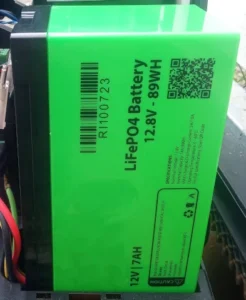
Lithium batteries have a strong safety record when they include a proper Battery Management System
(BMS) and are matched correctly to the charger. The risks below are real but are almost always tied to poor-quality batteries, incorrect installation, or mismatched charging — not to the battery itself when done right.
- Thermal runaway risk with poor-quality cells. Cheap, uncontrolled lithium batteries (particularly unbranded or non-LiFePO4 batteries) can overheat if damaged, overcharged, short-circuited or extreme environmental temperatures. This is significantly less likely with LiFePO4 batteries specifically, which is the more thermally stable lithium type and the one generally recommended for gate motors — but it isn’t zero-risk.
- Charger mismatch. Gate motor controllers built for lead-acid charge profiles (SLA or Gel) can overcharge or undercharge a lithium battery if not adjusted or replaced with a lithium-compatible charger/controller. This is one of the most common real-world risks, and it’s a configuration issue, not a battery defect.
- BMS failure or absence. The Battery Management System is what protects a lithium battery from overcharge, over-discharge, overheating and short circuits. Cheaper batteries often cut corners here. Always confirm the battery has a genuine, functioning BMS before installation.
- Physical damage. Punctured or crushed lithium cells are more prone to failure than lead-acid if physically damaged — a relevant consideration for motors mounted in exposed or high-traffic areas.
- Extreme heat exposure. Direct, prolonged exposure to very high temperatures (e.g. an unventilated motor housing in direct sun) can degrade any battery faster, but lithium cells are more sensitive to sustained heat than lead-acid over the very long term.
Bottom line on risk: a quality LiFePO4 battery with a proper BMS, installed with a compatible charger, is a safe and reliable upgrade. The risks above are almost entirely avoided by sourcing genuine batteries and having them installed or assessed by a technician who confirms charger compatibility — rather than simply swapping the battery yourself.
Which Should You Choose?
- Choose SLA if: you want the lowest possible upfront cost, your area rarely loses power, and you’re happy replacing the battery every 1–2 years.
- Choose Gel if: you experience regular but not extreme power outages, want somewhat better deep-cycle performance than SLA, and your gate motor’s controller supports (or can be set to) the correct Gel charge voltage.
- Choose Lithium if: your area experiences frequent or extended power outages, your gate works the motor hard (heavy gate, long travel, poor alignment), you want to minimise how often you think about your gate battery, and you’re willing to pay more upfront for a longer-lasting, lighter, more consistent solution — and you ensure it’s a genuine LiFePO4 unit with a proper BMS, fitted with a compatible charger.
Not sure which your current setup can support, or want us to check whether your motor’s charger is Gel- or lithium-compatible before you buy? Contact us today by calling 082 681 1955 or WhatsApp us.